
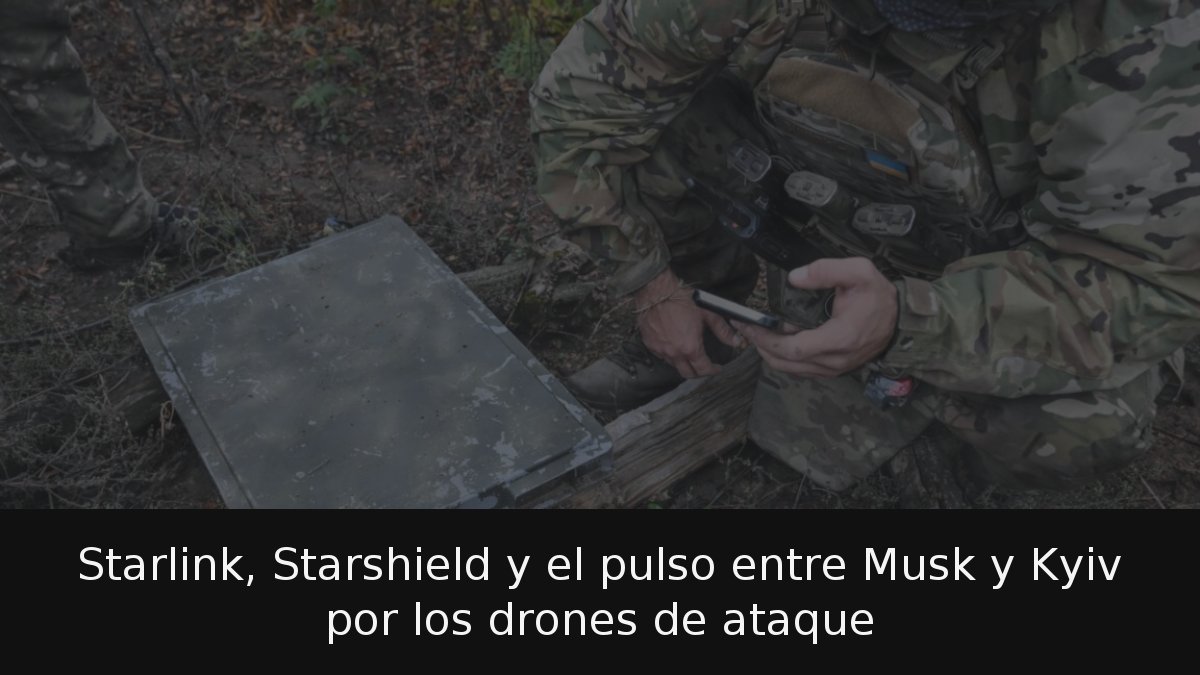
Elon Musk has reopened a quarrel with Kyiv, charging that Ukraine’s armed forces broke Starlink’s service conditions by turning the commercial satellite system to attack drones. In comments on Saturday, Musk said SpaceX had blocked that avenue last week by capping terminal speeds on unmanned aircraft. Ukrainian officials answered quickly, insisting that limits already in place had long ruled out the use Musk described.
- The charge: Musk asserted that Ukraine’s military employed civilian Starlink for “offensive drone strikes to kill people” and said the company had shut the opening.
- The denial: Serhii Sternenko, a former drone adviser, and Serhii “Flash” Beskrestnov, now a defense-technology adviser to President Volodymyr Zelenskyy, argue that a 43–56 mph cap and the lack of coverage over Russian-held ground make such operations technically unfeasible.
- Civilian versus military: Starlink is SpaceX’s commercial network; Starshield is its military counterpart. Musk says Washington controls Starshield, and Kyiv reaches it under an arrangement with the US government.
- Consequences: A ten-day loss of connectivity disrupted air defense and came at a high point of US–Ukraine tension.
Musk’s post, a Zelenskyy screenshot and the pushback
Writing on X, Musk stated:
“The Ukrainian military violated Starlink’s terms of service and used it for offensive drone strikes to kill people. That loophole was closed last week.”
He also argued that letting a civilian network serve lethal purposes had never been acceptable and should not become so. Alongside that, he shared a screenshot in which Zelenskyy said Ukrainian forces “also use Starlink for medium-range attacks.” Kyiv’s side says the president was talking about Starshield difficulties and used the Starlink name loosely.
“As someone who was inside the process at the Ministry of Defense, I can say with certainty that this is not true,” Sternenko wrote on Telegram.
Beskrestnov, Zelenskyy’s defense-technology adviser, said it was “very strange” that SpaceX’s owner would be unaware of restrictions that had been active in Ukraine for months.
The technical case: 70–90 km/h and no service over Russia
According to Beskrestnov, civilian terminals registered in Ukraine are capped at 70–90 km/h—roughly 43–56 mph—and do not function on Russian territory.
“Therefore, it is physically impossible for us to use commercial Starlink for long- or medium-range attack operations,” he said.
FPV attack drones operate below those speeds and depend on radiofrequency links; they are too small and carry too little power for even a Starlink Mini. Satellite connections are used instead for longer-range missions flown by larger, faster craft such as the Hornet fixed-wing drone, and for interceptors pursuing targets at up to 265 mph. Those missions require Starshield. Ukrainian officials have accused Musk of restricting their Starshield access.
Earlier events support that account. In February, SpaceX agreed to block Starlink over Ukraine and Russia and to limit access to whitelisted terminals. Users could register equipment, but links remained subject to the speed rule; connecting while moving required a special list running on Starshield. In early October, Starshield links lost high-speed connectivity, disrupting deep missions and interceptor control. Ukrainian authorities confirmed the caps were lifted on Saturday and service restored.
Who ordered the cuts, and where Kyiv is looking next
Responsibility for the cuts remains unclear. Musk says Starshield falls under US government control. President Donald Trump said he was not the one who decided:
“It doesn’t matter whether I called or someone else called. In short, he turned it back on.”
Vice President JD Vance suggested coordination from the White House. Musk added:
“If Starlink were turned off, the Ukrainian front would collapse immediately. This is not a threat, it is simply a statement of fact.”
Starlink billed $5.25 billion in the third quarter of 2026, compared with $3.1 billion a year earlier. Consumer subscriptions brought in $3.12 billion, while government and enterprise clients—including the Pentagon and the governments of Poland and France—accounted for $2.13 billion.
Kyiv and its partners are moving faster to find substitutes. Polish Deputy Defense Minister Cezary Tomczyk outlined his country’s plans, and Ukraine announced partnerships with Norway, Finland’s Nokia and satellite manufacturer ICEYE. The EU is developing IRIS², although first launches are not expected before 2029.
The episode leaves Kyiv with a difficult lesson: its capacity to strike distant targets and maintain air defense rests on a service whose technical and political keys lie beyond its borders. Saturday’s restoration improves operations but does not remove the structural vulnerability. With trilateral talks due next month, satellite infrastructure has become a source of diplomatic leverage comparable to any battlefield weapon.
Fuentes y referencias
- Elon Musk’s dust-up with Ukraine on Starlink isn’t over yet
- Ukraine disputes Musk’s claim Starlink was used for offensive drone strikes
- Zelensky adviser slams Musk over claims Ukraine violated Starlink terms
- Ukraine disputes Musk’s claim its military violated Starlink terms of service
- ‘Physically impossible’: Ukraine hits back at Musk over Starlink restrictions, disputes offensive drone strike claim